

Back in the late 2010s, the Australian singer–songwriter Harriette Pilbeam found her sound in the form of an ethereal, glittery indie pop that led her to her solo-project Hatchie. Thematically, Hatchie has always gravitated toward romantic longing, the memory of love, and the ache that idealism can bear. With this tender space between sweetness and sorrow as a source of exploration, to Hatchie love is something felt deeply, lost slowly, and remembered vividly. Across her work, she therefore found her lane to wistfully channel the bittersweetness of nostalgia, often drawing on the cinematic language of tragic romance or coming-of-age aesthetics.

With her roots in the indie pop sphere and never shying away to explore her sound further, she now fully devoted her sonic discovery journey to the dreaminess of 90s alt rock and proudly declares her third album “Liquorice” to be “the culmination of everything [she’s] wanted to do with this project”.
Melancholy in Motion
For “Liquorice”, Hatchie found thematic inspiration in the love relationships depicted in the tragic 1960s romance movies “Splendor in the Grass” (1961) and “Les Parapluies de Cherbourg” (1964). [As an author’s side note I must mention that these movies have not aged well, both from the depiction of age-inappropriate relationships, the (mis)treatment of women and their mental health, as well as in the case of the French pendant, the geo-political consequences of an active colonial power trying to defend falsely claimed territory in North Africa. For the sake of this review, I will highlight that these movies have had their time in the sun in the era they were released in and are considered classics of the tragic romance movie canon but I also must press the before mentioned grievances.] Both movies tackle motifs of a young, naive but intense love that is faced with the grim reality of a world burdened by societal expectations and economic decline, and see both couples drift apart, only to reunite for a single devastating moment of bittersweet reconnection.

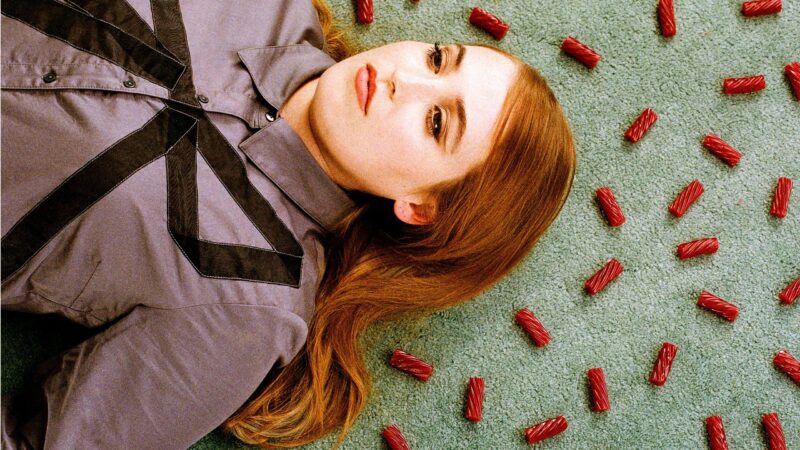
Photo by Bianca Edwards
Hatchie took some vital moments of these love relationships and explored the complex layers of love and intimacy, in all their desirable and devastating beauty. From intense infatuation to the melancholic afterglow of relationships, the singer bares a vulnerability that is as trenchant as it is compassionate. Where Hatchie holds space to tell of the passionate yearning for that person that dims any other matter to a mere flicker on the periphery of your mind (like in the title track ”Liquorice”), we get to listen to the fragmented aches of heartbreak (“Someone Else’s News”) or the reminiscing about a longing matured, bruised, and being richer for it just as much (“Carousel”).
Something about the way you said,
you felt me slipping through your hands
Left me wondering, tumbling
We laughed until our cheeks were numb
Paid no mind to what was yet to come
Even if it meant all our chips were spentWhen there’s nothing left you can understand
– Lyrics from “Carousel”
Shoegaze and Cocteau Twins
Musically, “Liquorice” walks the delicate line between ethereal dream-pop and the more grounded murk of shoegaze — a balancing act that few achieve so emotionally as Hatchie does here. Her gauzy, reverb-drenched guitars and distant vocals summon the hallmarks of shoegaze: wash, drift, enveloping texture, all the while never abandoning a pulse of intimacy. Hatchie and her producer Jay Som (Melina Duterte) fully devoted “Liquorice”‘s soundscape to the trail blazing Cocteau Twins. You do not need to listen for long to catch their nods to the musical lineage of skillfully layered, reverbed guitars, soft airy vocals, and melodies that feel as if they’ve been pulled from the ether rather than written on paper.

But Hatchie doesn’t imitate so much as translate. She takes the Cocteau-esque palette — the glistening high-end shimmer, the submerged basslines, the softly blooming harmonies — and stretches it across her own emotional geography. Songs swell and contract like breath, allowing space for vulnerability to seep through the haze. The production leans into a kind of luminous density: thick enough to feel engulfing, yet translucent enough for every melodic line to glow at its edges.
Bittersweet Aftertaste


‘Liquorice’ Album Cover
In the end, “Liquorice” feels like a love letter to the moments that linger long after they’ve slipped from our hands. The cover art already hints at this state of mind: a close-up of Hatchie’s content, almost cheeky smile, eyes closed, lips smeared with the evidence of a recent make-out session. It’s not a portrait of longing for what’s lost, nor a rueful admission that something has ended. Instead, it radiates a soft, confident appreciation — a recognition that even fleeting sweetness is worth savoring. That ethos permeates the entire album: love as something tender, messy, ephemeral, and profoundly formative. By the time the final notes dissolve, “Liquorice” leaves you with the taste of bittersweet joy — the kind that stays on the tongue, reminding you that every moment of connection, however brief, is its own small miracle.
“Liquorice” by Hatchie is out now. Follow the artist on Instagram.