
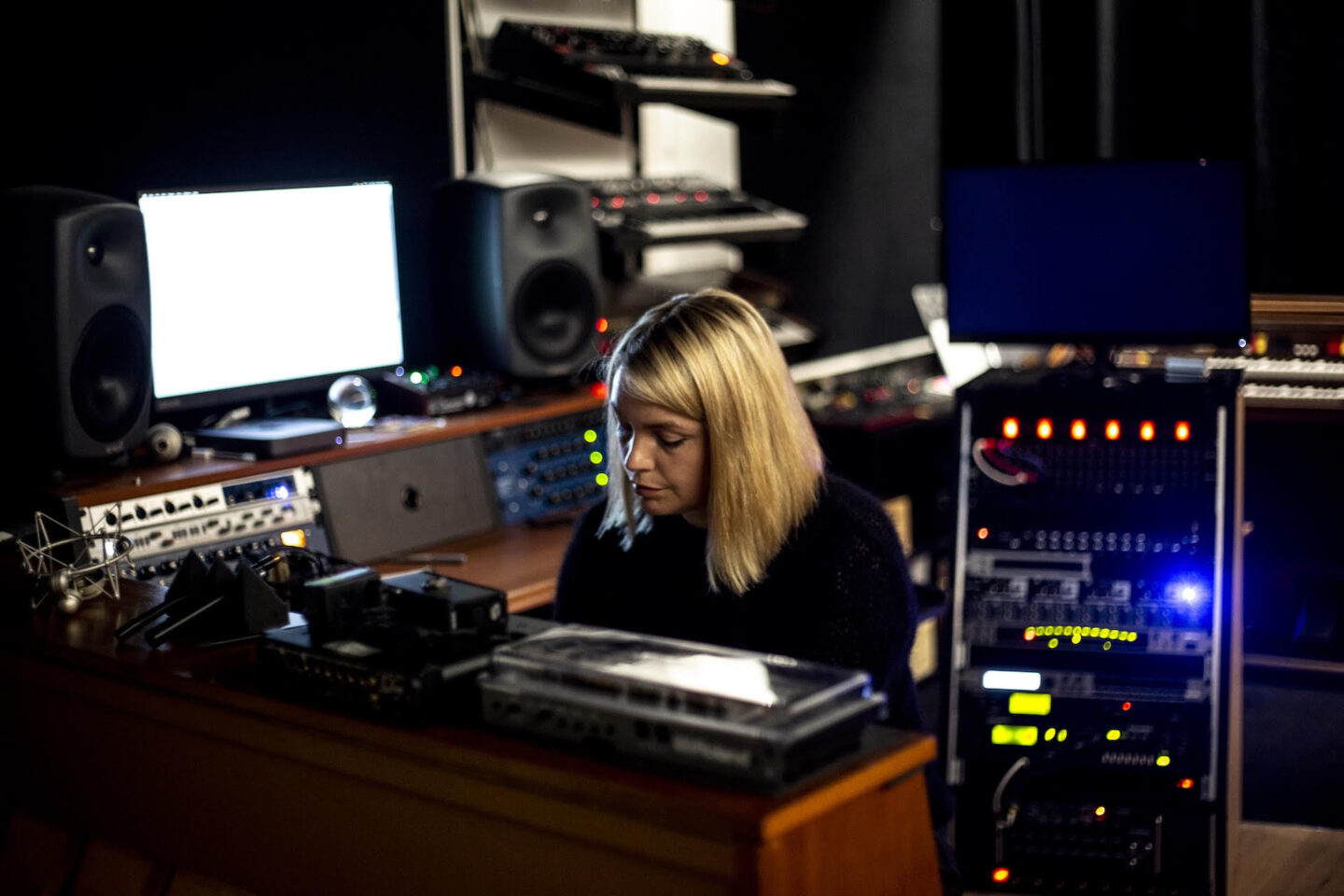
Emika is a recognised independent artist, who moved from the UK to Berlin to explore the electronic music scene. She has worked with the likes of Marcel Dettmann and Amon Tobin, was released on Ninja Tunes, and has an impressive discography spanning over 17 years, including one of my all-time favorites She Beats. The first time I saw her perform was with a hybrid live set at Boiler Room at Stattbad Wedding, I believe in 2013. During the set, she tried to bring in a real-time livestream of a dancer; she was too far ahead of her time, and the stream glitched. I can no longer remember why I attended the event in the first place since I had not heard of Emika yet, but I know that as I walked out, her style—both musical and technological—was engraved in my mind.
Over a decade later, Emika is re-designing her studio, re-visiting her composition habits, and bringing spatial audio to her audience with her new album, plus listening sessions and a planetarium tour. This isn’t her first time exploring how both acoustic and electronic sound work in space to add depth and build three-dimensional experiences—and I bet it won’t be the last. Emika is not only a composer, producer, and vocalist, but also the type of artist who integrates technology as a part of her creative practice from start of process to finish, thanks to her University Creative Music Technology degree.
I was lucky enough to be invited to discover the album ahead of the release in a movie theater in Berlin. Sitting in a super comfy chair and feeling cozy in the dark space, I listened, surrounded by other music lovers. It was not only a treat, but also a way to fight the corporatization of the industry: we all can listen consciously and take back our power as fans so music remains an experience and doesn’t devolve into background slop. After the listening session, I had a chat with Emika about her process of renovating her studio and creating the album, all while building her new family life in the Black Forest.


A Team Effort
Nadia Says: Emika, this album was not only a journey to create music pieces, it was also a journey of crowdfunding and discovering a new practice to compose, how did you make all these pieces fit together?
Emika: Each song on the Fountain Immersive album has the ingredients for things I wanted to explore with immersive music. We first crowdfunded on Kickstarter “How To Make Music Immersive”, rebuilt the studio and sorted all of that side, in parallel composing music and booking the orchestra, planning mic setups and recording techniques. Lots and lots of thinking and planning and discussions with the engineers and producers went into the project. We then went to Prague to record the string orchestra and choir, and then came back to EMIKA Records Studio in Germany to record my vocals, synths, and the Kawai grand piano.
My team travelled over from the UK as well for mixing in the final stages. At that final stage, I was mainly looking after my kids and happy to give my team new opportunities and the studio to play in. I’ve made so many records totally alone, this is a much bigger sort of production, one that I am able to step in and out of when either the artist of exec producer brain is required. I loved being guided and advised by my team – to see their creativity flourish with the freedom I kept giving back to them: the way we work is my team give me many beautiful options, and it’s fun to give them back too and decide things through collaboration.


What did this multi-faceted experience teach you as an entrepreneur, a technologist, a composer, and as a performer?
That partnerships build on trust and delivering on what’s been agreed, they benefit from openness and honesty. That change is integral to everything working, while planning remains essential; all of them – plan B, C and D, and money doesn’t make projects good by default. I would also add that artists are bridges between worlds and technology must be exact and precise.
I also learned art and music need not be perfect – just good, to further respect people’s time, especially fans, listeners, the people who care about your work, and to appreciate the influence your audience has on your music, to be there and make music for them.

A Gift for the Mourning
While you deeply evolved as an artist, you also experienced personal growth?
My mother passed away during this project. Her journey of passing was like the journey of a butterfly. If you listen to the lyrics of the track “Butterfly”, and the way the strings are composed, ascension, the movement in the strings… it frames all of this experience beautifully. Composer Bernat Vivancos understood this idea very well and helped me to turn this song into what it is. I think the lyric ‘I helped to wash her breasts’ is one of the most beautiful lines I managed to write so far. I never heard anything like this in a song. I hope it will become a gift and a sense of relief for many listeners who have ever cared for a loved one during illness and passing.
How does this change or evolution affect your creative practice and your personal life?
I have definitely retired from my previous music industry life, the miseducation I didn’t pay for but sunk into my perception of how music has to be released and treated in campaigns and all that. There’s much more peace, calm, openness and patience in my business decisions now. It benefits my health and my output greatly. Once you really start to understand music is all about people, shared experiences, opinions, friendship, reflection, movement… it all becomes glorious again. The psychology of streaming culture and the industry can make you sick, but you don’t have to get sick from an industry state and can still be successful with your craft. Independence helps to not get stuck in such environments.

Quiet Refuge
You moved from Berlin to the Black Forest, what did you gain by being away from the big city?
Nature!!!!!! I always struggled with anxiety… Turns out I just needed to live somewhere else. I didn’t know life could be this sweet. I hope more interesting musicians will come and work in my studio on their own projects. It’s so lovely and inspiring here.
You mentioned that this time around, you would like to stick to your project and go deeper, but will the pull to move onto something new be stronger?
The pull for something new is always the strongest. I think I will have to integrate all of the pulls and pushes into the next project. But first I will perform Fountain Immersive live in many planetariums – I’m confident this coming tour will lead the way into what comes next. No more dates will be added. After this I am back in the studio and will start something new, keeping within this blueprint.
The album is dedicated to all women composers who came before me, and who will come after me: together we are the fountain.

Catch Emika on tour, all dates HERE and follow Emika on Instagram.