
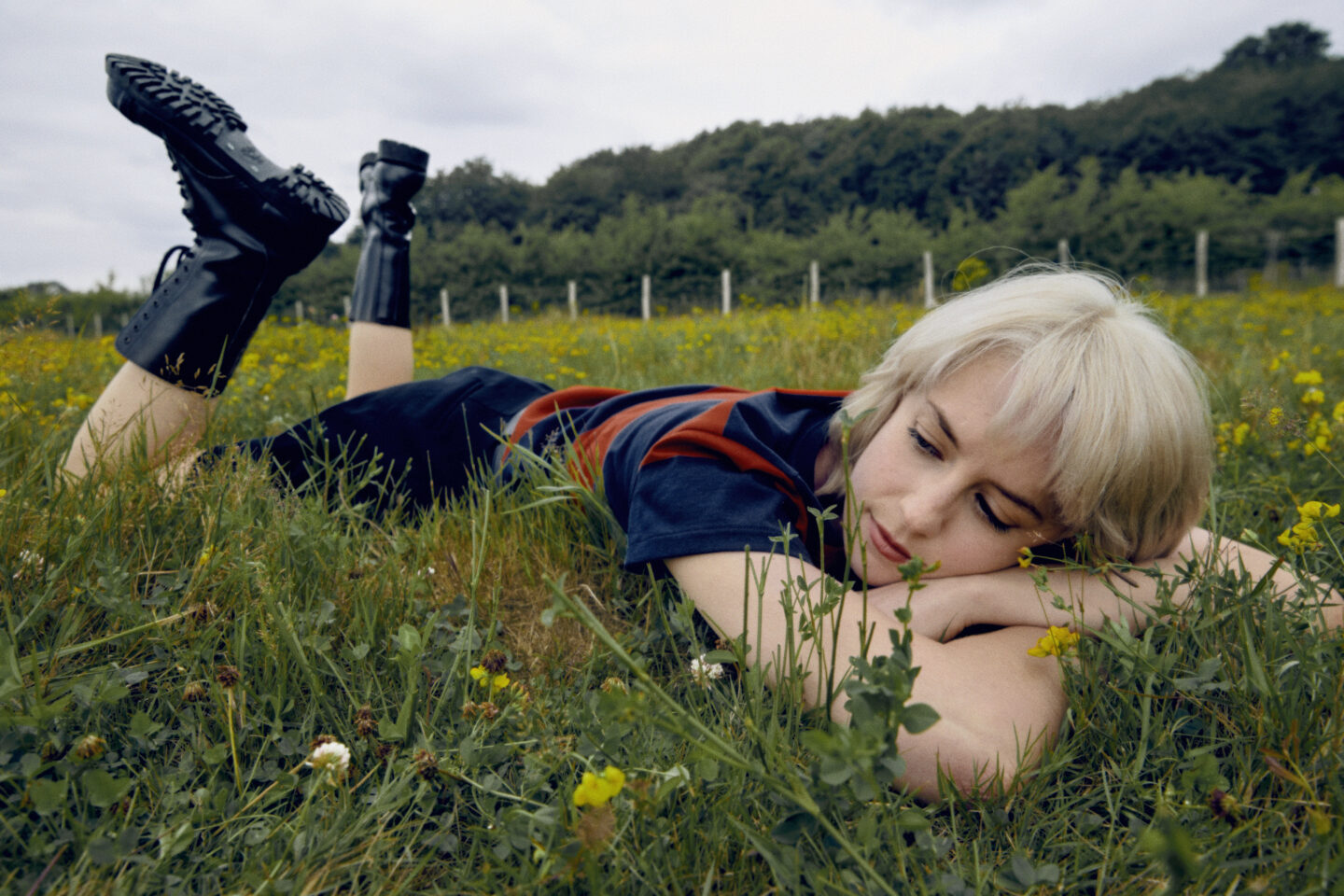
DJ and producer Avalon Emerson is a well-loved figure in the world of dance music. There are Reddit threads called “Go see Avalon Emerson if you ever get the chance.”, “Avalon Emerson. What makes her so good?” and “Avalon Emerson appreciation” describing her technically sharp but emotionally expressive sets that feel narrative and surprising rather than functional. Not one to shy away from weirder left turns, the Bay Area native has long embodied the “DJ’s DJ” archetype, a status earned over more than a decade behind the decks.
Her fondness for curveballs, it turns out, extends beyond club culture. In 2023, to many a raver’s surprise, she introduced Avalon Emerson & the Charm, a band project that positioned her as a song-forward live artist, complete with her own vocals and indie-leaning songwriting. She is now set to release the second album under this outfit, titled Written Into Changes, via Dead Oceans — a label best known for its melancholic, guitar-centred indie catalogue and home to artists such as Mitski, Khruangbin and Phoebe Bridgers.

The pandemic made her, like so many of us, question her life choices and allowed her to open up time and space for new ideas. “I don’t think I would have had the time, or the emotional space, to make an album like this before, even though it has always been something I wanted to do,” she tells me over a video call from her home in rural upstate New York, reflecting on the first & the Charm record. That album is full of glistening melodies and dreamlike atmospheres, deliberately reworking the synth-pop of her youth into light-hearted pop songs. Written into Changes is a continuum, but with more experience and greater confidence. It’s no longer an experiment; it’s lyrically denser, with a more dynamic arc of tension throughout the album.
Parallel Modes
To many a ravers’ relief, however, this was not her exit strategy out of dance music. After the album cycle for & the Charm, with a run of live shows, Emerson pivoted back toward club-focused material, launching her Perpetual Emotion Machine single series in 2025. Designed as a return to dance-oriented production, the project coincided with a new 9000 Dreams-branded touring show, giving her tracks she could reshape across different club contexts. With 2026 set to include both the release and tour of the new & the Charm album, alongside major festival appearances, Emerson has found a workable balance:


Photo by Lillie Eiger
“How I present myself as a DJ and how I present myself as a songwriter, they don’t feel very different to me.”
Despite both modes being means of expression, not contradictions, the creative process is quite different. The banger you hear during one of her club sets might have been produced just hours earlier on a plane. “I’ll open up Ableton, make it really quick, and then DJ it that night,” she explains.“Maybe I’ll change something, then play a new version at the next DJ set. It’s an open draft that I’m moulding over the course of a bunch of weekends and I’ll end up with some kind of proven end result.” Writing an album to be released by music industry standards and then toured operates on a completely different timeline. “So much work happens behind closed doors,” she says. “There’s all the work that the label does, the album art and all this kind of stuff. It’s released into the public years later. So it’s definitely a different and more nerve-wracking experience.”
DJing, by contrast, has become second nature.“I can lean back on some of my experience and the music that I’ve been listening to and collecting for a decade of being a professional DJ and knowing how to mould an experience that way on the dance floor,” she says. “It’s more of a conversation, I guess. Not to be too highfalutin about a DJ set, but it is more of a back and forth dialogue with the dance floor.”

Initially, trying out the band format sounded like a fun experiment, but it turned into one of her biggest career challenges. This was especially true when it came to live touring: “There’re so many more technical things that can go wrong. So massive respect for people who go out and do that on the regular.” While one might argue that DJs are now just as much in the focus of a crowd and camera lenses, being on a stage, performing original songs for fans who came just to see her put a newly felt pressure on the artist. “I already had a little bit of a name for myself. So even though it was my first band project, we were playing festivals and sold-out shows. And so the right skill curve was very steep,” says Emerson, who never had to go through the shitty-bar-gigs-stage newcomer bands know too well, but that also meant learning how to build a rig or sing in front of large crowds with little margin for error. Intense yet rewarding:
“At its best, music is an expressive format. And I wanted to talk about the things that I see as truths and my experiences. Operating in a lyrical medium it’s this entirely new and very rich open field to play with and it feels like a new set of skills, it’s a new canvas to paint with.”
After the Noise
Was the shift toward dream-pop textures a response to changes within dance music itself — a scene that has grown faster, harder and more commercial in recent years? “I’ve been professionally DJing for maybe 10 years now, and there’s always been a kind of multi-year oscillation between really hard, really fast and things that are more minimal and a little bit slower,” Emerson answers. Still, she notes that the post-COVID period brought something distinct. “A lot of dance music, clubbing and festivals were affected by people’s inability to go out. People came into a going out age, but only experienced dance music via online DJ streams and social media clips. So then when they come out to a club, they didn’t know how to act.”


Photo by Lillie Eiger
The same goes for DJs who gained notoriety on social media during this period. Playing in front of a crowd certainly feels different to playing in front of a camera in a tiny tiled room. That disconnect, she suggests, helped push things toward extremity. “I think there was a push towards harder and faster stuff because you can get a reaction out of a crowd if you just play really hard and fast,” as Emerson further describes. “In the first couple years after things opened up again, I heard stuff on dance floors that I had never heard before. I heard an entire Black Eyed Peas vocal on top of like some speed garage and I thought, ‘Whoa!’ You would have been laughed off stage if you had played that five years ago.”
“But I think that has kind of burned out.” After some years of chaos, Emerson feels the pendulum swinging back toward curiosity rather than shock value. “People are going deeper and into more interesting places.” What she misses, though, are thoughtful, sustained conversations about dance music — discussions increasingly flattened by algorithms and short-form content. Working within a band, at a slower pace and in collaboration with other musicians, offers a partial escape from festival trends and TikTok DJs discourses. “I’m making my stuff,” she says, “and I’m very thankful that I have a couple different avenues with which to interact in music.”

Written Into Changes is out March 20 on Dead Oceans. Catch Avalon Emerson & the Charm live in Berlin on April 8 and follow the artist on Instagram to find out about any upcoming DJ sets.