
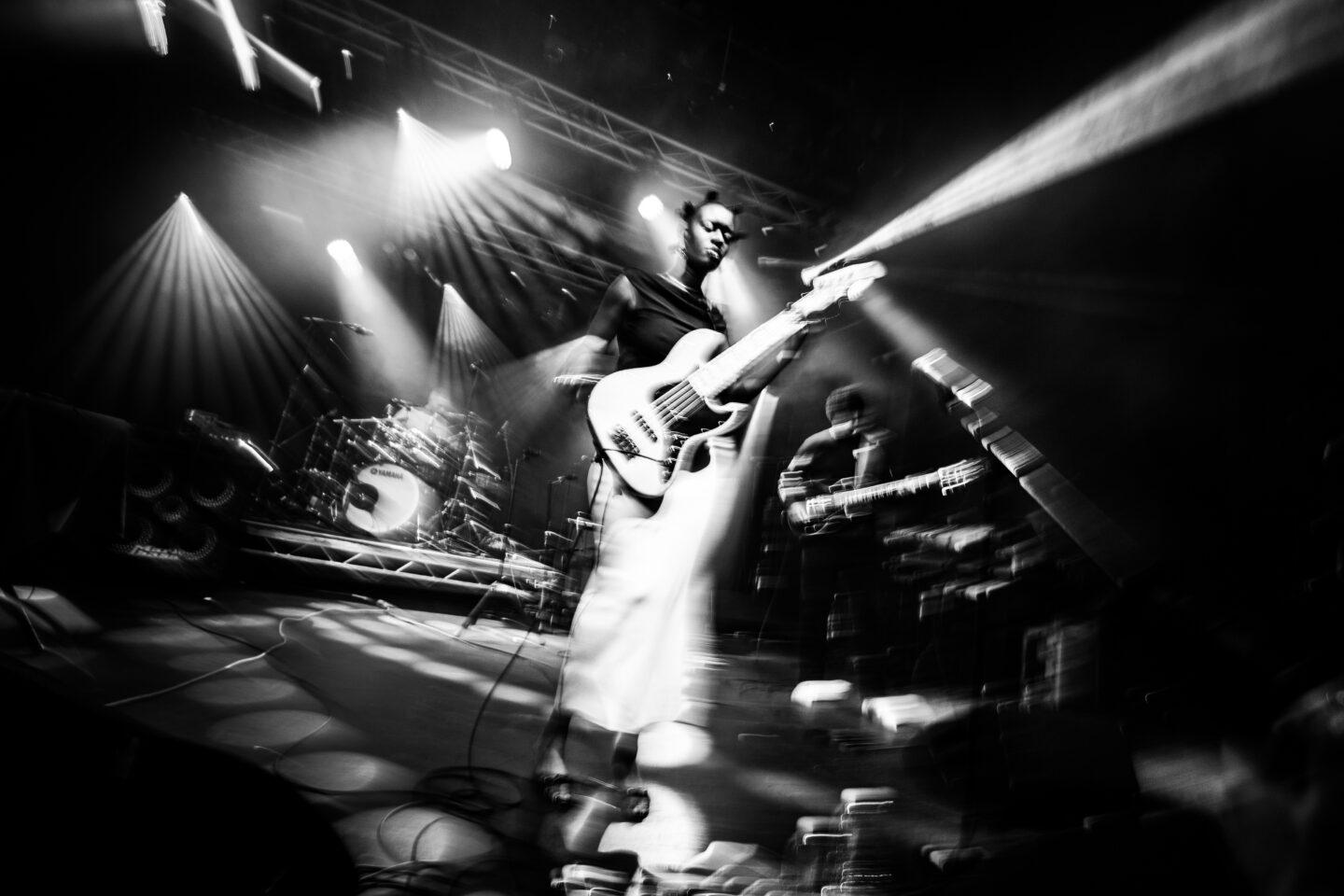
It’s a chilly Friday night in Berlin when I video call Marla Kether, though for her, the day is just beginning. She’s sitting on the lower deck of a tour bus parked up in Fort Worth, Texas, having just driven overnight from Austin. There’s a brief lull before soundcheck, a few hours before stepping onto another massive arena stage, with stops in Denver, LA, and Seattle still ahead before wrapping up the US leg of the tour.
Between touring as a session bassist for major acts, DJing, and self-producing, Marla Kether wears a lot of hats, and wears them all brilliantly. But today is all about Luso, her brilliant second EP blending samba house, batida, and high-energy broken beat. As she puts it with a grin, after two years of work, seeing the tracklist finally go live on streaming: “To be able actually to click on this one is just surreal. Best feeling ever.”
Alice Vyvyan-Jones: So Luso is out in the world now. How do you feel?
Marla Kether: I feel good; it’s actually mad! The reception already, especially for the tracks that weren’t singles, is just really good. It’s like two years of work finally out in the world, so it’s a proper relief. Now that people have heard it, I just want to dive into the backstories and give everyone the context behind the tracks.
I’m curious, what were you listening on when you listened back to the full EP?
I listened to it top-to-tail with the band on the drummer’s JBL speaker after our show in Austin. It’s just surreal… before an EP comes out, you see all the tracks blacked out on streaming, so to actually be able to click on them and play them is honestly the best feeling ever.

The Making Off
You’ve brought some amazing collaborators onto this project. How did those partnerships come together?
It’s a mix, really. Some are people I’ve worked with before, like Sofia Grant, or artists I’ve admired for ages, like Mez. I met Margarida in Brasília last year, so that was a brand-new collaboration. For “A Jam in Parnamirim”, I actually met one of the guitarists on Instagram back in 2020! We’d been messaging on and off, so when I went to Brazil for two weeks, I was like, ‘I’ve got this demo, let’s drum it out.’
How did the timeline and concept for this EP evolve?
After my last album in 2023, I spent 2024 just making stuff without any set plan. Then in 2025, I made the demo that started “A Jam in Parnamirim”, went to Brasília to flesh it out, and started chatting strategy with my manager, Quinton. Over the winter, I worked with my friend Val on what became “Reverse”, wrote Run the Track in December, and then made “Libera” out in Lisbon in January as a companion piece to “Parnamirim”.
How much of what we hear on the record was meticulously planned, and how much was created on the spot in the studio?
It totally depends on the track. “A Jam in Parnamirim” was completely improvised; we just jammed out a 40-minute session, and I went in post and chopped up the best bits. With “Run the Track”, I brought a full demo into the studio, but we adjusted things on the fly with the band, like deciding on the day to take the bassline an octave up in the bridge just to give it more energy. “Libera” was more self-contained because I was producing it as a remix, so I could be as spontaneous as I wanted with the bassline.

Thekla Thursday Girlie
Let’s talk about your degree, because you studied chemistry at Bristol University. Tell me, is there anything from a chemistry degree that actually translates into being an independent artist?
Honestly, the only thing I take from it is spreadsheets! Being able to stay on top of my earnings, tax returns, and numbers as a self-employed girl…that’s literally all I use it for!

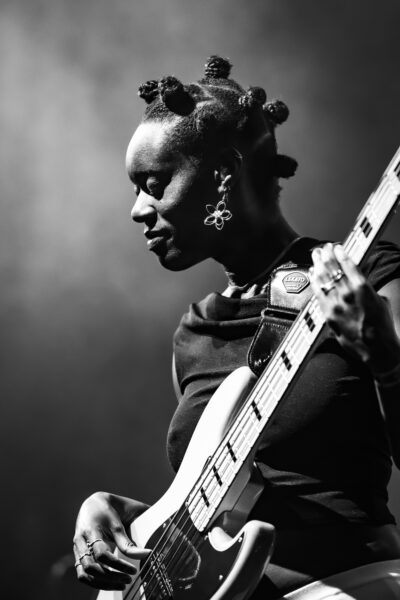
Photo by Dominic Le Brun
As someone born and raised in Bristol, I know how incredible the nightlife and music education here is. What was your experience of diving into that local scene during your uni years?
Oh, it was amazing… like a proper golden era. I was a total Thekla Thursday girlie! I was always at the jams at The Social and Mr Wolf’s, or catching shows at Thekla, The Gallimaufry, and Left Bank. Playing out every week built my confidence and taught me how to collaborate with people I didn’t know. And because I was studying chemistry, music wasn’t under any pressure; it was just this pure, incredible release.
Going from playing giant stadium crowds as a session bassist to stepping out front for your own solo project, how different does that energy feel from the stage?
Playing huge crowds is pretty surreal. When you’re playing to 20,000 or 200,000 people in a field, the crowd just becomes this amorphous blob, which actually makes it way easier to perform! The smaller, intimate rooms for my own shows are way scarier because you’re making direct eye contact with everyone. But playing with big artists teaches you so much about how to be an artist, how to put on a show, and how tour logistics work, which is massive when you’re DIY and doing all those back-of-house roles yourself.
Supporting Each Other
Tell us about your current US tour; how has it been making your way from the East to the West Coast?
We started in Orlando on the 15th, and we’re basically working our way across. Tonight we’ve got a show in Fort Worth, Texas, and then it’s Denver, Arizona, San Francisco, San Diego, LA, Portland, and Seattle. It’s been so amazing playing these sold-out arenas and just connecting with people.
Support acts are such a vital part of live music. How do you approach choosing support acts for your own shows?
Support acts are so key. You want people who don’t just align with your sound, but with your values and beliefs too. You want someone who feels like a friend you can hang with, someone who creates a great vibe for everyone, and who acts as a genuine warm-up for the night. The clue’s in the name…it’s support!
For my London show in November, I’ve got Zamar Eden supporting; she’s an incredible upright bassist and Black woman in the jazz scene, so it feels really special to support another Black woman bassist. Plum, who plays vocals in my band, does these amazing loop pedal sets, so I’d love to have her support too. And if I could open for anyone else? Esperanza Spalding, ESG, or a co-headline with TC & The Groove Family; their music aligns so nicely with mine.

Points of Reference
You’ve mentioned that DJing global club sounds, house, and Lusophone music has really fed into your production. How much of that global approach goes back to what you were listening to at home as a kid?
A lot of it, honestly! Growing up, my parents played so much Congolese music around the house, loads of Ndombolo and Soukous. I grew up with those typical family hall parties where everyone gets together and plays Congolese bangers until 4 AM. That sound is baked into how I write. On a track like “In My Corner”, you can hear the Congolese influence straight away in the clave rhythm and the guitars. Even on a more UK funky, jazzy track like “Morning Light”, the guitar still has that Soukous flare; high-pitched, staccato, and echoey. That’s always my reference point.
Speaking of reference points, is there a specific track or baseline that is the ultimate benchmark for you?
For me, “I Know You Know” by Esperanza Spalding is the pinnacle of bass. It’s jazz with a Brazilian influence, and the way the bassline and vocals interact is just nuts. Esperanza is my favourite bassist of all time!

Luso by Marla Kether is out now. Stay up to date with Marla Kether via Instagram and her Bandcamp.