
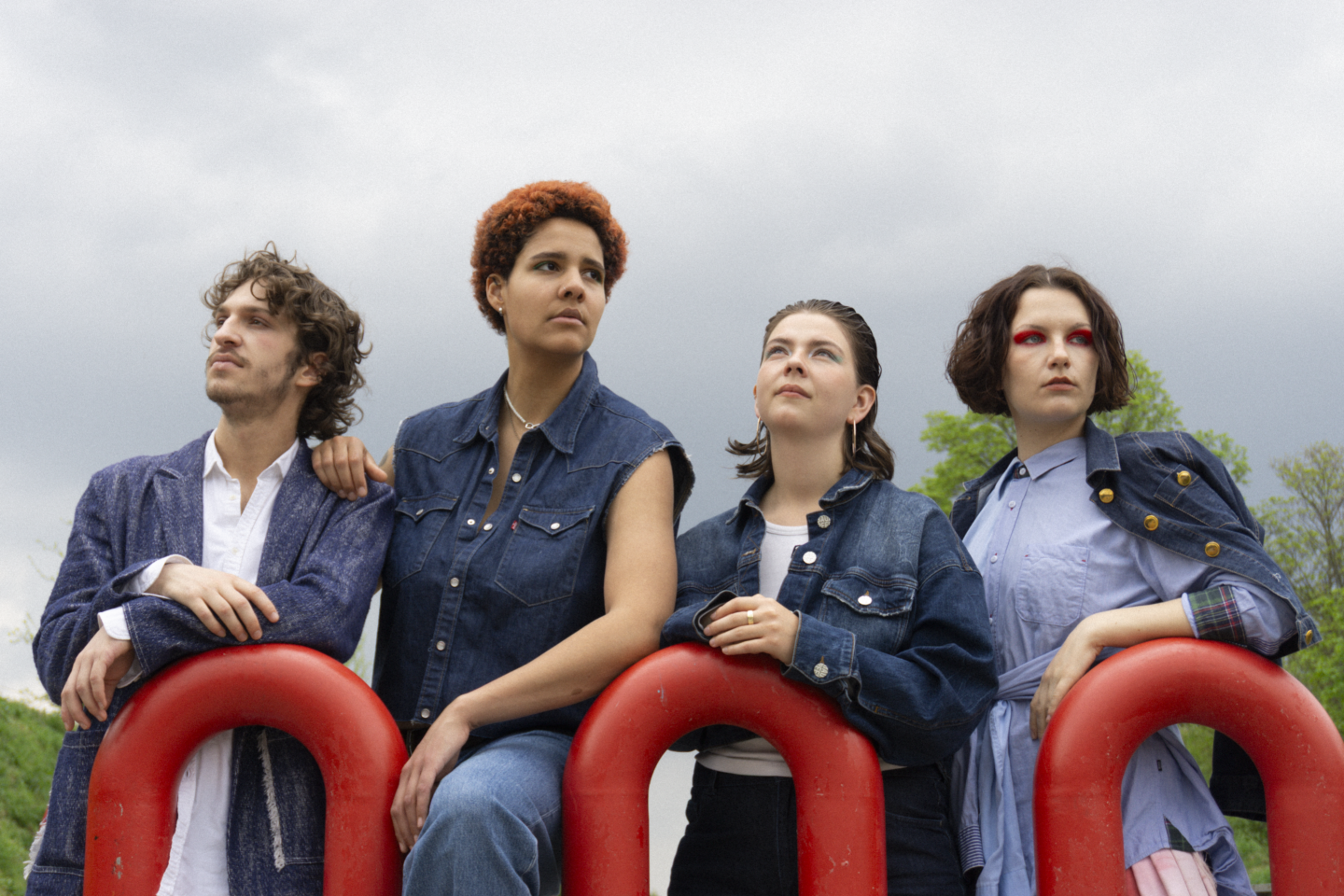
In a city overflowing with bands, SO SORRY stand out not by being louder, faster, or more virtuosic, but by being attentive. Moving fluidly between contemporary jazz, alternative pop and R’n’B, the Berlin-based quartet balances vulnerability with a sense of collective strength, making space for softness without ever slipping into fragility. Social critique is present throughout their work, but never as didactic statements. Instead, they’re woven into music meant to be danced to, sung along with, and felt in community.

The Beginnings
Founded in 2023 and performing in their current line-up since April 2024, SO SORRY consists of Zuza Jasinska (vocals), Käthe Johanning (keys), Shanice Ruby Bennett (bass), and Lenny Rehm (drums). Their debut EP “WE ARE SO SORRY”, recorded at Brewery Studios and set for release in January 2026, captures a band that has finally found a way of making music that feels fully aligned with who they are.
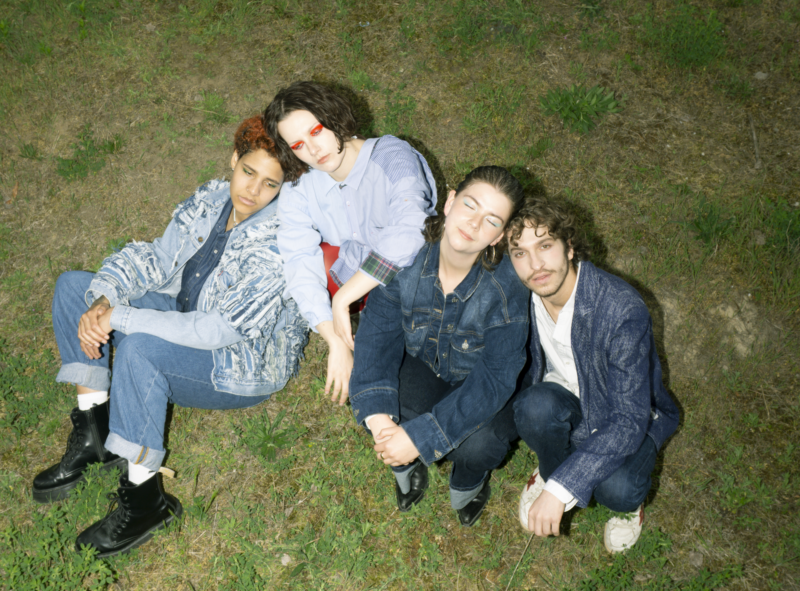

I met Zuza and Käthe on a cold December afternoon in Berlin, at the end of a year that had decisively shifted the trajectory of their band. In 2025, they won both the Sparda Jazz Award and the Junger Münchener Jazzpreis, building on the momentum of the 2024 Musicboard Berlin scholarship. The conversation quickly moved between reflection and anticipation: how the band had arrived here, what they had learned along the way, and what it might mean to step into the next chapter together. Questions are answered carefully, often collectively, circling back to how things felt rather than how they were supposed to be.
More Than Representation
“It was so natural. And to this day, it all feels very natural,” Zuza tells me, talking about how the band came together. “There’s an invisible bond that keeps us together. It’s very special.” Having played together in various forms and projects before, Zuza, Käthe and Shanice took a trip to Hamburg in 2023. After a few days of jamming, multiple songs emerged, and suddenly, without forcing it, a band had formed. SO SORRY started out as a FLINTA trio, deliberately attempting to create a safer and calmer working environment in a scene that is still shaped by exclusivity. “We really wanted to be in a FLINTA group,” says Zuza. “Initially, we were searching for a FLINTA drummer.” When Lenny Rehm joined the band in 2024, it wasn’t a dilution of values, but rather a test of priorities. “With Lenny, we just instantly clicked,” Zuza continues. A compromise without losses, as Käthe adds: “Eventually, we realised that our band is political anyway; we don’t have to force it. As three FLINTA musicians connected to queerness, we are political anyway.”

With all of them having studied jazz in academia, the band members are used to male dominated spaces. A 2025 study by the Berklee Institute of Jazz and Gender Justice found that only 15% of jazz faculty in the US identify as female, dropping to just 8% among instrumentalists. While comparable data for Germany is scarce, there is no reason to suspect a vastly different situation. This leads not only to a lack of non-male role models, but also to a narrowing of the idea of what a “true jazz musician” should look and sound like. “From the beginning, you learn these attitudes, especially in jazz, where it’s all about superlatives and being this musical genius. It’s about playing fast, playing loud, being confident and not showing your insecurities,” explains Käthe. “In these male-dominated groups, I realised that I can’t fully be myself. I have to perform, and ultimately, I’m really close to reproducing their toxic behaviours.”
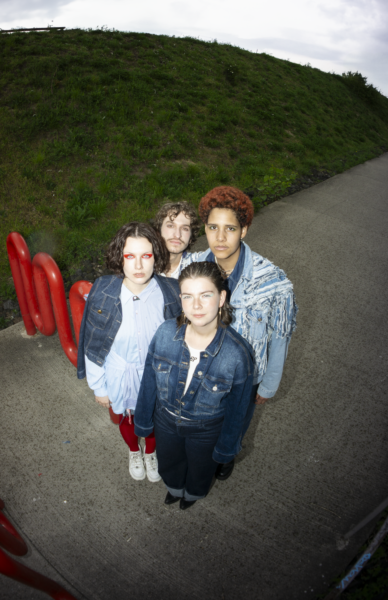

It’s not just about what they project; it’s also about how they operate as a band. “When Lenny joined us, we had already created and established a different kind of space. I learned that I can live my values with male-socialised people too,” says Käthe. “The band showed me I can get to a state of feeling safer—and being able to share the space no matter what gender.”
Care as a Creative Resource
Zuza tells me of the open communication within the band. “We always ask each other how we’re doing, and we actually want to know,” says Zuza. “If someone’s on their period, we take that into consideration.” That ethos of care carried directly into the recording of “WE ARE SO SORRY“. The band spent five days at Brewery Studios—a timeframe that allowed songs to evolve organically rather than being locked into pre-determined shapes.
“SMALLER KEYS” shifted form completely over the course of a single day. “The song sounded so different in the morning, it sounded wrong to all of us,” Zuza recalls. “But suddenly it just fell into place, and we had a completely different song.” What remains is a laid-back yet intricately layered track, built from distorted textures, fast piano runs, and a prominent, grounding bass lines. Elsewhere, “WE ARE SO SORRY“ allows itself moments of fragility. “TAKE ME” unfolds as a sparse, atmospheric ballad, its beauty lying in restraint. Frail and spacious, the track leans into vulnerability without dramatizing it, offering a pause amid the EP’s denser arrangements. The communal spirit of the record reaches its peak on “GIAW (God Is a Woman)”. Anchored by a head-bopping groove and spoken-word contributions from SORVINA, the track culminates in a mini choir recorded on the final day of the session — friends gathered in the studio. “That’s the nicest part of that song,” Zuza says. “It captures the pure brilliance of what community can achieve.”
It’s to no surprise, that SO SORRY’s songwriting process is a collective endeavour. Most songs begin not with lyrics or charts, but with jams — exploratory sessions that are recorded, revisited, and slowly shaped into compositions. “A really SO SORRY way of writing is us jamming together,” says Zuza. “We just play and listen back. No sheets involved.” The whole band structure is unusually democratic. “We all contribute at the same percentage,” Käthe explains. “We would never sound like we do with different people.” Zuza adds: “We know exactly what our roles are in the band. There was never a fight about who does more or less. That makes it very healthy.”

Stepping Out of the Bubble
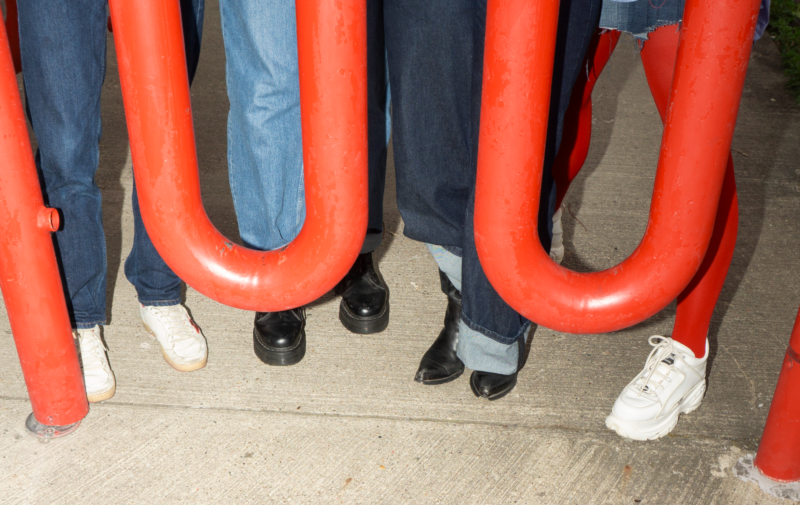
Even with their clarity of purpose internally, SO SORRY wrestles with external labels. With their intricate melodies and tightly woven arrangements, it is difficult to categorise their sound. Despite their shared roots in jazz, they are reluctant to be associated with the term. “We call ourselves more an alternative pop band,” Zuza explains. “We can’t hide the jazz influences, but the moment you mention jazz, people put you into a box. But then jazz people say you’re not jazz enough.” So, opting for alternative pop is less a rejection of jazz than a strategic positioning. Improvisation remains central, but not in the form of endless virtuoso solos on stage, rather as an approach to composition. “In a way, we all ended up doing jazz studies and learned about the magic that can happen when you just jam,” Käthe adds.

It was with “WE ARE SO SORRY” that the spirit, admiration and care for music and each other found expression. “We’ve been in our own bubble for a long time. Now, we can finally say, ‘This is what we’ve been working on.’ I want us to show ourselves off,” admits Käthe, smiling. “Because I know we’re good. We practised so much with our instruments, and now everything fits.”
“WE ARE SO SORRY“ is out 23 January 2026. Catch SO SORRY live at Notwache Hamburg on 22 February 2026; Gretchen Berlin on 12 March 2026; and Franz Mehlhof in Erfurt on 13 March 2026. Give them a follow on Instagram, too!
All photos by ALKARLINE.