

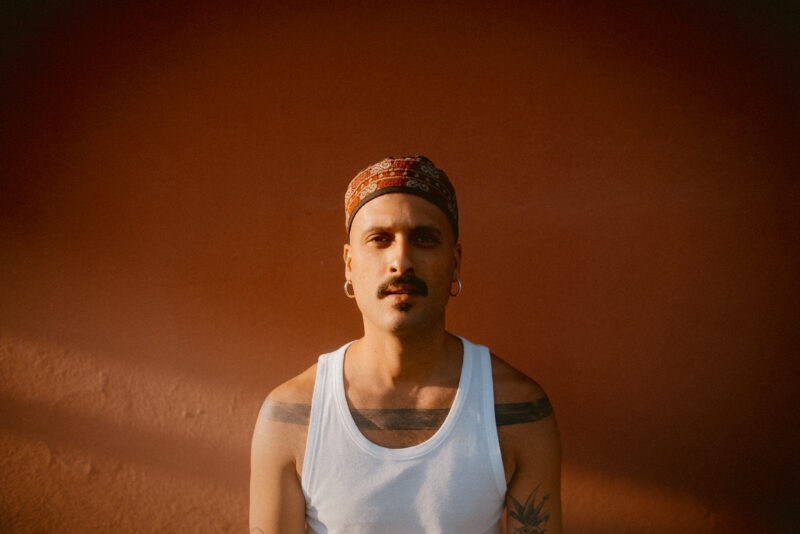
Based out of Berlin, the artist and founder of Palestine Music Space in Ramallah for young musicians, Ahmed Eid, is well connected in the local and international music scene. Having played as part of several band projects like Bukahara, his musical expertise ranges from piano, double bass, and percussion to trumpet. He now released his debut LP min ghazzeh la baghdad min haifa la beirut (من غزة لبغداد من حيفا لبيروت) via the independent label KINDA. Written during a period of solitude in the Jerico countryside in Palestine, Ahmed Eid reflects on what it means to be Palestinian amid an ongoing genocide and decades of apartheid and oppression. Musically, the record expands on previous releases with funky pop-rock compositions and layered electronic and acoustic textures. It is accompanied by music videos showing glimpses from everyday life in neighborhoods close to the artist’s home, like Downtown Ramallah and the mountain village Farha.
In this conversation, Ahmed Eid shares his creative vision behind the new record. We also chat about the role of music in struggles for liberation, boycotting European grant institutions and platforms like Spotify, and why we need more spaces for young Palestinian musicians like Palestine Music Space.
Telling Your Story
OFFKEY: What were your first steps in music?
Ahmed Eid: I was born in the political exile of my parents in Jordan and right around the corner, there was a summer school for kids to learn violin. That was my first time playing a musical instrument at age six. When we later moved to Palestine, we got a Casio keyboard, and I got hooked on playing melodies on it, so my parents signed me up for piano lessons. When I came to Germany to study, I had to decide between piano and upright bass, my two main instruments at that time. I ended up studying double bass and until now, I feel the most comfortable to express myself with musically, even though it is not the instrument I play the most nowadays.
Why did you decide to go solo after so many years in band projects?
Music is something very personal and it can feel intimidating to play in front of people even when you are in a band. It took me some time to feel ready to put myself out there as a solo artist. But at some point, after touring with a lot of different bands, I had the urge to tell my story and share my perspective of the world I live in. That’s why I started writing my own music.
Did you notice differences in the role music plays culturally in Palestine versus in Germany?
I think everywhere around the word music brings people together. In Palestine, like in other places around the world, the culture around music has been less co-opted by money driven structures that charge people thousands of dollars to access musicians and gatherings.
I grew up in an environment where music is deeply connected to community and there as a form of expressing and sharing emotions.
Expressing Lived Reality
min ghazzeh la baghdad min haifa la beirut (من غزة لبغداد من حيفا لبيروت) is your debut album and all the songs on it were written during the ongoing genocide in Palestine since 23rd of October 2023. Did you follow a certain vision with the record or was it more a document of processing all these emotions that came up during that time?
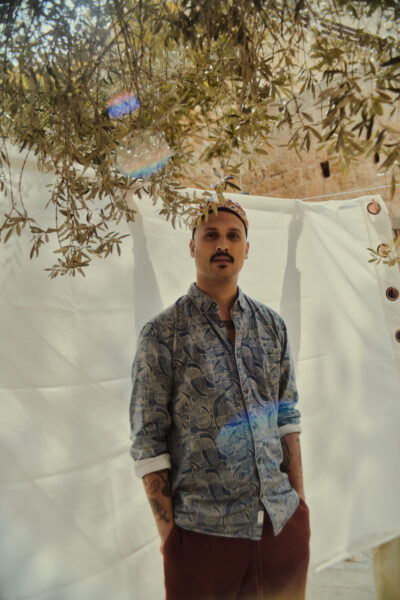
Photo by Tian Sthr
It was both – I had a vision, but it was very much driven by emotions. With every musical project, my vision is the same: to imagine a parallel reality to what we are currently living in for myself and the listeners, and to explain my personal experience, which is also a collective experience of Palestinians. The situation in Palestine has been oppressive and intense for decades already. Living in this reality has always been present emotionally and in my writing. One of the songs I wrote for my previous record, Aghani Akhira, speaks of a father who lost all his children and is trying to get his last remaining daughter to sleep. The song was written before the genocide in Gaza and shows that this situation has been there long before October 7th. Of course, things have become more intense and acute since then. I deal with these emotions by channeling them into music. On the new album many songs specifically talk about the genocide, like “ashiqeen” for example, which imagines living a love story in Gaza amid the genocide.
The album title means Gaza to Baghdad, from Haifa to Beirut. Why did you choose that title?
The title speaks to a collective nostalgia for a time pre-Zionist occupation and pre-imperial colonialism present in many generations living in the SWANA region. After WWI artificial borders were drawn by colonizers isolating people from one another. In the Arab speaking world, we are connected to our neighbors through language, culture and sometimes even lineage. But because of the borders, we cannot move freely. I think that nostalgia for connection and freedom beyond borders is something many people from that region can relate to.
Messengers and Magicians
What role do you see music playing in fights for liberation in the context of Palestine?
Music is deeply personal. The stories we tell through music, lyrics and melodies can really catch the attention of listeners and spark curiosity about different realities. When I listen to music, I want to find out who the person behind it is, and what their story is. To me, musicians are in a sense like messengers and magicians. They can turn a message into something that penetrates the hearts of people. That is magical. And to move people can be a very powerful tool.
Do you think music can influence political realities – or mainly emotional ones?
I believe that our actions bring forth change. Our choices matter and it’s in our hand how we show up in the world. Making music or creating spaces like the Palestine Music Space is a part of that.
If done right, and with the right team, then music can chance peoples lives, their experiences, their realities. It can mobilize people and that spark of mass mobilisation can change everything.
Collective Action
You recently left the streaming platforms Amazon and Spotify in boycott. Can you talk about that decision and how it has that affected you as a musician?
We live in a world where large exploitative companies are controlling the market. We need to navigate the world we live in and sometimes that means compromising and engaging with these structures. Streaming in general is exploitative and not made for musicians to thrive.
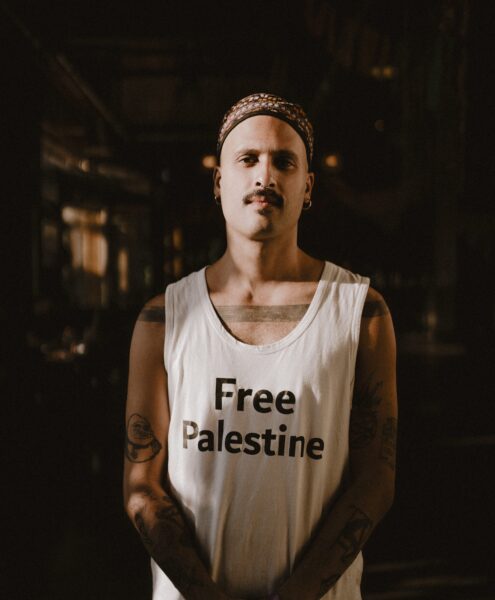
Photo by Danny Kötter
There are red lines, which made it impossible for me to stay on Spotify and Amazon. They championed streaming, AI and other exploitative practices and then started to invest into technology that murders people. As those are the platforms most people use, I lost a large group of potential listeners. Regardless, I cannot compromise with companies actively taking part in a genocide. I also want to set an example for others because boycott only works as a collective action.
We decided to focus more on real connections and live shows. That’s why for our community in Berlin we went for a two day event on June 11th and 12th where people will be able to participate with their own inputs via an open call instead of a big concert hall release show. More than ever I feel the need to be in spaces where we can freely gather and express without compromising what’s right.
In Germany the repression and criminalization of Palestinian voices and mobilization intensified since October 7th. Beyond that, you also shared a recent experience with a grant institution threatening funding withdrawals if using words like genocide and apartheid. How do you perceive the situation at the moment living and working in Germany as a Palestinian artist?
There is a real systematic repression of Palestinian voices and political art in Germany by the German ministry of culture and structures that used to help out artists in need like Initiative Musik are being co-opted by that. Me and many other artists who are outspoken about the genocide, apartheid, and German complicity have lost gigs because cultural offices tried to blackmail venues into cancelling our shows. Many funding structures are conditional, which means you get money but are not allowed to use certain words, speak about certain things or work with certain groups – in the context of Palestine often even humanitarian groups who are considered terrorist by Israel, the US and some Western countries. I reject any conditional funding. But there is also a quite solid scene of community organizing around Palestinian liberation here in Berlin working against systemic repression. There is Reclaim Narratives, Palestine Speaks, Jewish Bund, and many more.
Living under a system that is extremely oppressive and complicit in what is happening in Palestine especially Gaza, it is even more important for these groups to organize and to connect.
Creating Space to Thrive
I want to speak about your work with Palestine Music Space – a free of charge space for young musicians in Ramallah, Palestine. Why did you start this initiative?
The idea for Palestine Music Space came from my own beginnings in music. As a teenager, I dreamt of having a space to make music, to live the rockstar life. But such places didn’t exist during the time of the second Intifada. Music schools were institutional, more classical and conservative. Based on that experience, I realized how important it is for youth to have spaces, where they can meet and experiment with music. I started Palestine Music Space in 2022 with the help of Majd Hajjaj. In the beginning it was just me giving lessons twice a week to like 15 kids. Since then, it has grown so much. Now we have like 70 young musicians either playing solo or in bands, participating in classes or jam sessions. Everything we offer is free. I think that aspect is super important because it makes culture accessible to youth from less privileged families.
How does this younger generations of Palestinian musicians engage with the music?
Especially in Palestine where kids are living difficult and threatening situations every day, it is important to have places where they can just be. Expressing yourself and documenting your reality through music can be a way of processing experiences. It is also about creating a solid community. I have witnessed people from different backgrounds becoming friends through Palestine Music Space. That is why spaces for creative expression are foundational in building community.
Is there a band project or musician currently coming out of Palestine Music Space, you would like to highlight?
We recently released the debut songs of six young bands in an EP, among them some schoolgirl rock bands like Hatta or Fantazya together with KINDA , an independent label. You can support them via downloading on Bandcamp, watch them on YouTube and all other platforms (except Spotify and Amazon;) ). There is also Kareem Barakat, an incredibly talented musician, who moved to Berlin recently to study. I recruited him for my live shows who’s year. He will play on the 11th and 12th at our community mini festival and launch event near Jannowitzbrücke.
What are your dreams for Palestine Music Space?
For now, we need to find a new home because we unfortunately had to leave the space without prior notice. Beyond that, I hope Palestine Music Space grows in terms of finding a larger space and reaching more people. My vision is to provide free access to musical education for the wider region. I would also love to continue building ways to fund recording and touring for the bands that are growing out of Palestine Music Space at the moment. I think this could really shape the music scene in Palestine and beyond. We are currently funding the project by donations that mostly come from people I meet while touring Europe.
min ghazzeh la baghdad min haifa la beirut (من غزة لبغداد من حيفا لبيروت) by Ahmed Eid is out now via KINDA records. The release show will take place on 11 and 12 June in Berlin. Stay up to date with Ahmed Eid and Palestine Music Space.