


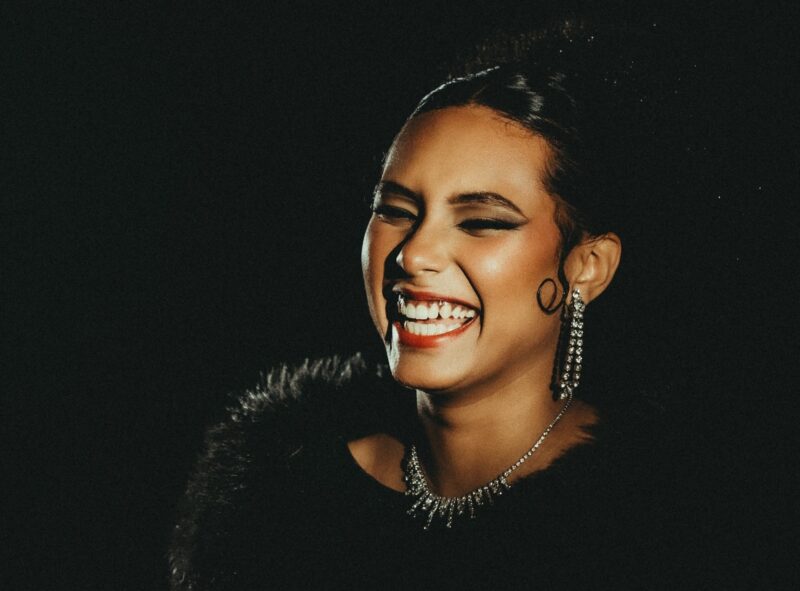
One of the first things to notice about Charlotte Colace is her radiance. Whether on stage or in conversation, the French-Cuban singer-songwriter bursts with a joy of life that is just contagious. Born in the South of France and growing up in a very musical household in Havana, Charlotte Colace was exposed to a broad selection of music from early on in her life. Her father collected music from all over the world and nurtured Colace’s diverse musical interest, never limited by language or genre but more so enriched by a fluid understanding of them. Traditional Cuban music coexisted with jazz, French varieté and US-American soul. All bound together by the emotional sincerity they conveyed through their music. Her mother, an actress, supported Colace’s talents from an early age, signing her energetic daughter up for dance and as well as different sports to help her find expression for herself.
“I was lucky enough to have a parent who was in the arts herself, who encouraged that part of me. If you’re not encouraged since you’re a kid to go towards that, you may never discover that it’s even a thing for you. I do believe I became a singer because my mom did encourage that part of me.”
Soul Is More Than a Genre
Creating cinematic music that draws on the warmth and emotional directness of 1960s soul, Charlotte Colace recalls turning inward to find her own musical expression, unfolding her spectrum of musical socialization. “I asked myself, ‘What do I like to listen to? I have so many influences, including Cuban music, and I love French music as well, like the classics. For me, the Varieté Française is just another kind of soul, just with another sound.” There was also Etta James, Amy Winehouse and James Brown, joining Édith Piaf and Ben L’Oncle Soul.
That old-school soul sound may be where she found her footing, but it is the emotional honesty behind it that the singer identified with so strongly. Reaching whatever sits underneath the words and letting that feeling dictate the music is what keeps pulling her back. “No matter what genre, the main element in my music will always be my soulful voice.”
To Colace, soul is a medium rather than a genre, a way to tell her stories. As her idols all shone through their emotional sincerity, sharing their pain and pleasure in their songs, so does Colace. There’s an immediacy and universality to her singing, where the words aren’t necessarily the first thing to enter your mind. Instead, the emotion does the translational labor. Like the pleading in her voice on “Lose You Over Lies” amplifying the desperation of a parting lover by a thousandfold. Whether Colace wanders into funk, jazz, reggae or draws from the musical traditions she grew up with, the soul remains. It is the thread connecting her influences, the constant beneath the changing sounds.
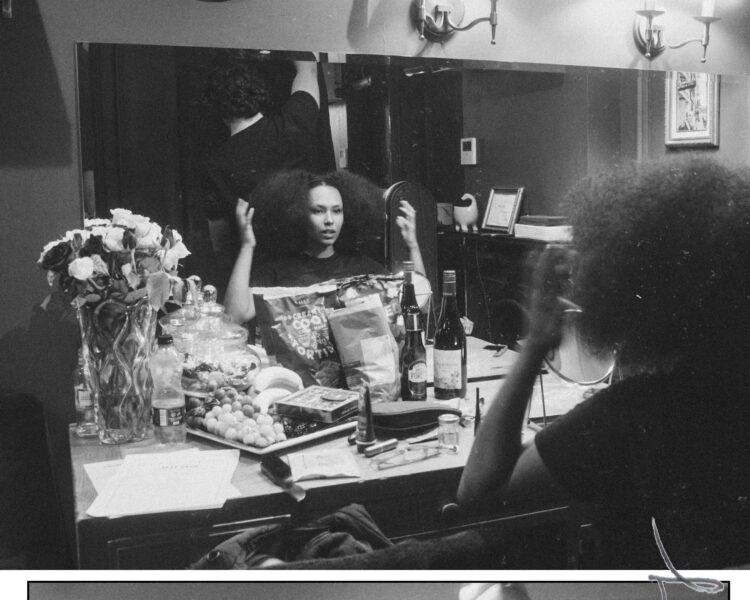
Photo by Nadine Schulzendorff
Against the Grain
For Charlotte Colace following her instincts meant going against the mainstream in her home country. “A big reason why I didn’t stay in Cuba was because staying there, I thought I would never be able to live off of my music. Especially doing soul, American- inspired soul from the ’60s even, which is considered the enemy’s music. And it’s in English, which most people don’t speak. It’s not salsa or cumbia or reggaeton or traditional music. I thought that no one would listen to my music in Cuba.”
Her feeling reflects a cultural divide shaped by decades of political tension between Cuba and the United States. The relationship of the two countries have long been marked by brutal US intervention and imperial ambitions, from political and economic influence over the island to the decades of hostility following the Cuban Revolution in the 1950s. Cuba’s struggle to determine its own political future and maintain sovereignty consequently ties itself to a broader resistance to US-influence. Against that history, suspicion towards American popular culture is understandable: music, language and cultural influence carry political weight far beyond the sounds themselves. Cuban musical traditions have remained deeply rooted in the island’s own history and identity. For an artist working in English and drawing from the sounds of 1960s American soul—a genre far removed from the music that dominate Cuba’s popular musical landscape—there was little space within the local industry.
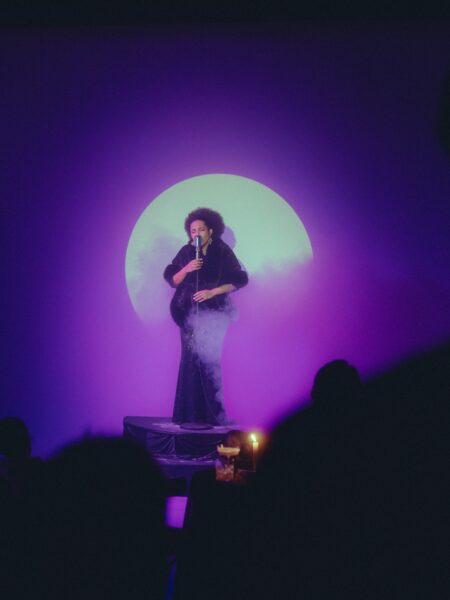
Photo by Shannon Kone
Nonetheless, the decision to leave her home and study in Berlin was not easy. “Moving from Cuba to go to Berlin and learning music here felt really weird, especially knowing that at least for me, most masters of music are in Cuba. It’s the culture of music over there.” Cuba has produced generations of musical masters, from Benny Moré and Omara Portuondo to jazz pianist Chucho Valdés, with musical knowledge passed down through families, institutions and communities. Leaving Cuba therefore did not mean leaving behind a place where music was lacking; quite the opposite. Charlotte Colace was leaving a country whose musical culture had shaped her deeply, even as she felt that the particular music she wanted to make had little room within it.
Coming to Berlin
Finishing her bachelor’s in professional musicianship vocals in 2022 at the BIMM (Berlin Institute of Modern Music), Charlotte Colace slowly but surely got involved in the Berlin scene. She performed in different band constellations and ventured into new sounds, at a steady pace of trial and error trying to make a solo project happen. “A lot of times they didn’t flourish because I still was at a point where I didn’t know what I was looking for musically.” Yet through the connections she forged at BIMM, to the likes of Sorvina and the team behind A Song For You, Colace found Black and BiPoC spaces where she was embraced in her totality, no need to ever dim her light or mighty voice. Talking about her first rehearsal with ASFY, for example, Colace was filled with joyful reminiscence.
“I had this thing, which I think a lot of members of A Song For You have felt, which is like, ‘Where have you been in my life?’, you know? Just emotional, pure. Like wanting to cry my life out of singing collectively and being so many Black and Brown people in this place. I just felt like I can be loud, I can be chaotic, I can be myself 100% and be accepted here. It really awoke something in me because I felt like, from 2018 till that point, I was lost.”
Finding connection in Berlin, Charlotte Colace met the producer Tremendous Aron through a network of friends and fellow independent musicians. In him, she saw someone who could help her bring her sonic visions to life. “I felt especially inspired by the sound of the 60s where soul and blues were really taking the lead in pop music. I was like, ‘That’s what I want to do!”, and Aron understood the assignment. But due to their localities, him in Leipzig and her in Berlin, and other commitments, at first it was not clear whether they even could collaborate. Yet, with the recording process being a fluid chain of writing, jamming, reworking and finalizing the tracks, they made it work. Mastering was done by Jan Gandi who really understood Colace’s vision.
“I wanted [the EP] to be grandiose and theatrical. That, if you were to listen to it in a room, it would be everywhere around you and take you into that world.”
No Way But Through
On No Way But Through, expansive lush arrangements create a film-noir-tinged, James-Bond-theme-worthy atmosphere, where the songs unfold almost as a cohesive cinematic experience, drawing the listener fully into Colace’s emotional soundscape. Lustering with the smoky elegance and intimacy of a dimly lit 30s jazz club and the sense of music spilling into the room. Just as if the listener wandered into the room with the band already playing just for themselves, while Colace examines love, healing and its hardships in a grand fashion. Yet beneath that vintage allure, the production remains spacious and immersive, giving Colace’s vibrant voice room to command the scene.
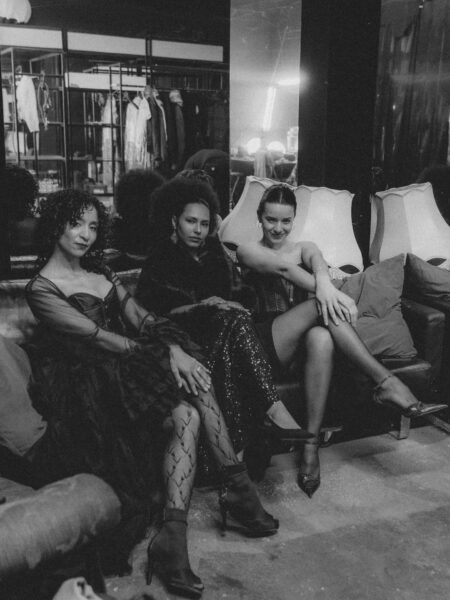
Charlotte Colace behind the scenes of her EP Listening Session | Photo by Shannon Kone
And command she does! Once she steps on stage, Charlotte Colace is one of those rare performers who yield a strength, seemingly rooting directly from the depths of their soul, yet deliver their message with such clarity, that you can’t help but follow them on their journey. Emotion becomes contagious. It’s not simply about singing to an audience; it’s the way she pulls us into the story, making us move and feel the highs, the ache and everything in between.
Touring with Stella & The Longos since 2022 or Sorvina and supporting artists like Curtis Harding on tour, offered Colace many opportunities to define her stage presence and playing with her band, honing a holistic experience with every performance.
If you want to catch Charlotte Colace live in Berlin, she will perform at the “20 Years F Cat Festival” at Festsaal Kreuzberg on November 14. For the special occasion, she joins Sorvina and Will Jacobs & The Unit on stage, in what promises to be a voluminous celebration of funk, blues, hip-hop and, of course, soul.
Listen to No Way But Through. Follow Charlotte Colace on Instagram.