


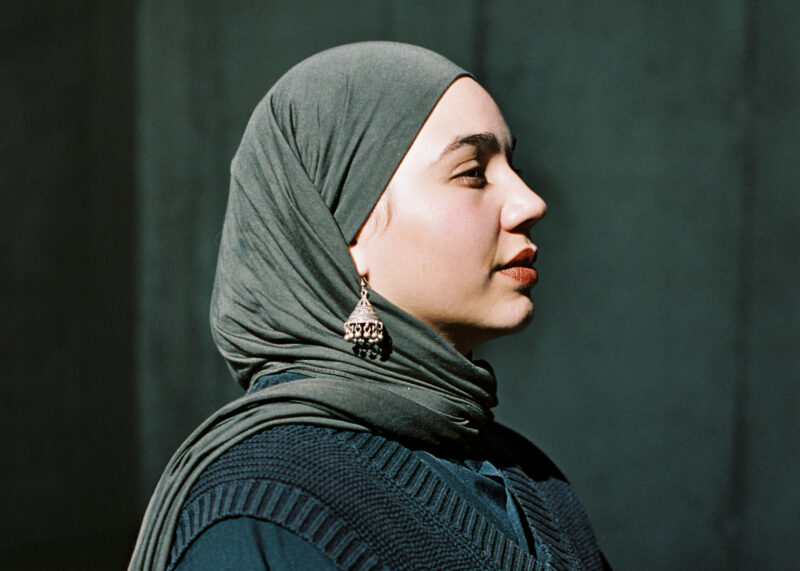
Ilo Toerkell: Rûveyda, let’s start at the beginning: What are your first musical memories?
Rûveyda: When I was a child, my mom used to sing me to sleep, and her singing always felt like home to me. It was the first time I experienced how deeply singing and music can shape our sense of safety and the way we feel inside ourselves. When I grew older, she stopped singing to me. Now, whenever I visit her, I ask her to sing for me, and for a moment, I feel transported back into that feeling of being a child again.
This image of a mother singing her child to sleep is at the heart of my upcoming EP. It begins with a recording of my mother singing to me — a song called “Kapat Gözlerini, Bak Yeşil Yeşil,” which means “Close your eyes and look to me, green green.” It is a song my grandmother used to sing to me, too. By having my mother sing it for the EP, I wanted to bring these two generations together and honor both women who have shaped me in their own ways, and who have helped me understand who I want to become — as a woman, and as a human being.
How did you go from that to pursuing singing on your own?
It took me some time to realize that becoming a singer was a dream I had carried within me for years. I grew up in a family and a system that taught me to choose a stable career, one that would provide security and financial independence. My grandmother, especially, emphasized this. Having experienced the hardships of being a guest worker in a foreign country, she knew what it meant to work hard to survive. And perhaps my family simply wasn’t used to the idea of a woman pursuing a life on stage.
When I moved to Berlin, I started jamming and performing at open mics. For the first time, I received feedback from people who didn’t know me, and it encouraged me to take something I had always considered a passion more seriously. I was afraid that turning singing into a profession might take away the emotional connection I had with it. But the opposite happened. With every performance, I grew not only as a singer, but also in my confidence and connection to my voice.
It took me a while to fully allow myself to call myself a singer. I had to explore, experiment, and discover what I wanted to bring to the stage. Today, I carry that part of myself with pride. And knowing that my mother and grandmother are proud of the woman I’ve become makes it even more meaningful. In many ways, I had to break patterns both within my family and within myself. I’m glad I chose to pursue the dream, even when staying comfortable would have been easier.
What role did music play in dismantling these internalized patterns?
Music became a space where I could really express myself, and because of that, it also confronted me with a lot of wounds I carry — my own and intergenerational ones. Through music, I started to see and understand them, and also understand myself in a different way. For a long time, I wasn’t able to cry because I was pushing difficult emotions away. Music, melodies and harmonies became a way for me to reconnect with those emotions and allow them to be there. Singing sometimes feels like a kind of cry to me — a way of letting something out that I might not be able to put into words. It also taught me that healing doesn’t always have to be harsh or confrontational, as if you have to tear open your wounds to face them. There are ways of allowing emotion and healing in gently, in a way that feels safe and natural. And I think there is also beauty in pain, in allowing yourself to feel it and finding something within it that can transform you.
Finding Yourself in Multiples
You grew up in Germany, and your music strongly draws on ancestral connection and tradition. Did you have to go through a process of reconnecting with that?
Of course, it was also a process of reconnecting with both my religion and my culture. I grew up in Germany, with a system that raised a lot of questions for me. What is my role as a woman within my religion and my culture? I started questioning the patterns I had grown up with and trying to understand where they came from. Over time, I realised that my relationship with my religion could be something of my own. I allowed myself to become a woman who is religious, while still finding my own way of understanding what religion and spirituality mean to me. That gave me space to find myself within my religion, rather than feeling like I had to become someone else to belong to it.
Looking at my culture and my roots also became part of the process when I started making music. My religion and my culture inspired me to make music and to become the artist I am today. I found something very personal in the melodies I heard through reciting the Quran. The maqam tonalities carry something that feels very close to the voice — they come from a feeling, but they are also musical and deeply personal to me.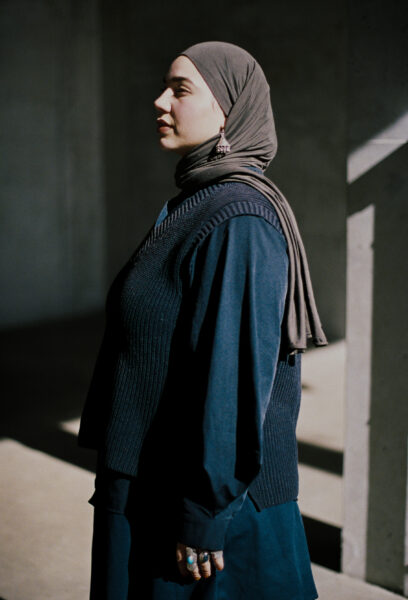
In my music, these different parts of me naturally come together. It carries traditional Turkish elements, but also maqam tonalities I learned through reciting the Quran, listening to Arabic music, and being inspired by the different cultures and languages I grew up with.
What were some songs or artists you listened to in this process?
There are so many old traditional Turkish songs that I feel connected to. I especially love “Hasret” (Sema Moritz). This song is one of my favorites because it feels almost like a cry to me. Âşık Veysel has also been one of the most inspiring poets and musicians for me.
I love the idea of searching through all these elements of my culture and slowly finding my own way of carrying them forward. There are not only Turkish elements in my music, but also Arabic and many other traditional sounds that have found their way into it. I was born and raised in Germany, and I grew up surrounded by people from many different backgrounds, so all of these influences became part of me in some way. I love Fairuz and Umm Kulhtum, for example, as well as Urdu and Hindi music. Finding connection to my own culture meant connecting to the cultures that affected me in my childhood. It is connected to all the cultures, people and sounds that shaped me while growing up. In a way, I am searching through all of these influences to find my own version of them.
Using Your Voice
How does living in Germany affect you and your process of dealing with your traumas and intergenerational trauma?
Growing up in Germany as a woman with another cultural background, as a Muslim woman, I think a lot about who I want to be and how I want to exist. I am often confronted with certain images of who people think I am, and sometimes it feels like I have to move around those images before I can simply be myself. It can feel quite constricting, especially because I don’t believe that anyone can tell me who I have to be — and especially not a system. But I think a system can make you feel like you have less power, like your voice has less value or doesn’t really matter. For me, music is a way of stepping out of that feeling. It gives me a space where I can simply express myself and use my voice without having to fit into someone else’s idea of who I am.
What is the songwriting process like for you? 
My music is very much rooted in improvisation. I am trying to reflect each moment in its most authentic and truthful way, and improvisation helps me meet every moment as it is and reflect it in my music. I look for the melody, the idea or the expression that feels true to what is happening within me and around me at that time. It also depends on who I am working with. When I work with instrumentalists, our stories, emotions and ways of expressing ourselves come together, and something new can emerge from that exchange. When I play live, I try to stay open to whatever I am feeling in that moment and let it become part of the music.
For me, creating music is a way of letting go, listening and being present. Everything we recorded for the EP is based on those kinds of moments — moments where we allowed the music to happen rather than trying to force it into a certain shape.
Sleep As a Metaphor
The EP Uykudan Uyan is centered on the theme of sleep, with the title meaning ‘wake up from sleep’. Why did you choose that focus and what does it mean to you?
Sleep becomes a metaphor for many different things throughout the EP. It can be the softness of being held, of feeling safe enough to let go — like a mother singing her child to sleep. This is where the EP begins, with the intro. But sleep can also be a place of numbness, of being somewhere between feeling and not feeling. In “Yarama Dokunma”, which means “please don’t touch my wound,” it becomes this feeling of not being able to remember, not being able to react, not being fully awake to what is happening. A woman who has learned to live without being able to say no, whose wounds can be touched without her being able to protect them. Sleep and waking become something more than states of the body — they become about consciousness, about finding your way back to yourself and remembering that you can have boundaries.
 There is also this longing to remain asleep in the arms of a mother. To stay small, to stay a child, before the moment of waking up and having to carry the things that come with growing up. In “Uykudan Uyan” it is about wanting to stay asleep in the arms of a mother, wanting to stay a child that does not grow up and does not yet carry the weight of trauma.
When I first started creating the EP, I was holding this very intimate image of a mother singing her child to sleep. But as I went deeper into it, I couldn’t stop thinking about all the mothers who cannot sing their children into a safe sleep. Mothers in places of war, mothers who are trying to protect their children from things no child should have to experience, and mothers who have already lost their children. The lullaby slowly became something much bigger than the image I started with. It became connected to the pain of the world, to inherited and collective grief, to the things we carry across generations and the things we wake up to, again and again. The EP lives somewhere within this space between sleeping and waking — between wanting to stay protected and having to open your eyes to what is happening around you.
Does the title also relate to witnessing what is going on in the world, rather than shutting your eyes to it?
Yes, there is this saying that sleep is half death. For me, sleep has taken on another meaning that I became really aware of when I started to feel this world pain more deeply. It is something that has always been there, something that has always existed somewhere within me, but through making the EP, I found myself going deeper into it. Especially because I wanted to carry this feeling of world pain into the story of the EP.
For me, sleep also makes me think about those moments when we don’t get to consciously decide when someone dies, or when a mother puts her child to sleep without knowing whether that sleep will be temporary or final. There is something so deeply painful about that uncertainty — about being confronted with things that are beyond our control, and with the reality that sometimes we cannot protect the people we love. And I think this is also what world pain means to me. Feeling the pain of people, even when their pain did not happen directly to you. Feeling the weight of lives that were lost through war, violence, and different systems, and carrying something of that grief within you. Maybe there is a reason why we feel these things so deeply, even when they are not our own stories.
This EP made me realise that we can speak for the people who are no longer here to speak for themselves. We can keep their stories alive. And we should not stop talking about them. For me, using my voice is also about this — giving space to the people we have lost, to the grief that has been carried through generations, and to the pain that does not simply disappear when someone is gone. In that sense, making this EP became a way of letting this world pain move through my voice. Not because I have the answers, but because I feel that there is something important in continuing to speak.
All photos by Ilo Toerkell.
Uykudan Uyan by Rûveyda is out now. Follow Rûveyda on instagram and find out more on her website.