


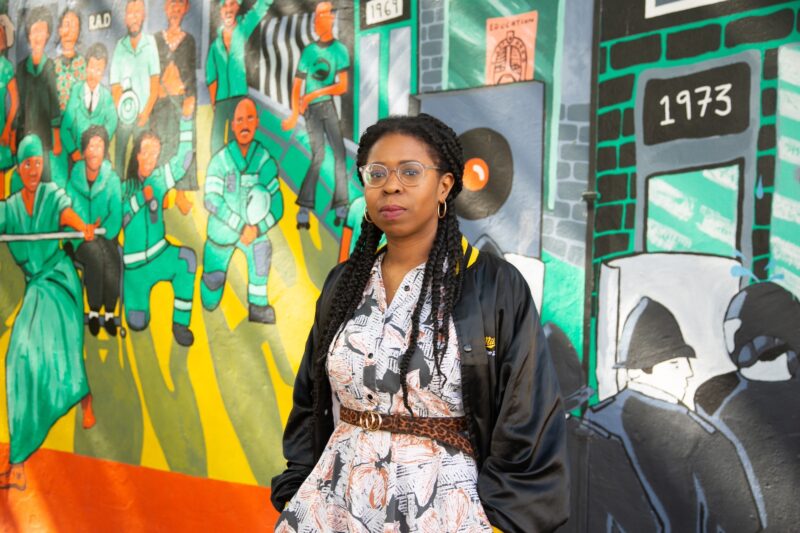
Musician and journalist Stephanie Phillips has been touring and releasing music with the Black feminist punk band Big Joanie since 2013. An avid lover of alternative music, she gathered extensive knowledge of the history and present of rock and roll and the genres that developed out of it. Now, she released her book “We Were Here: A History of Black People & Alternative Music“, compiling years of research, artist interviews and music into an extensive volume circling back to the Black roots of genres, which have been white-washed by the mainstream music industry. With OFFKEY, Stephanie Phillips spoke about her findings, the erasure of Black people from the history of alternative music and how its past, present and future can be reclaimed.
Ilo Toerkell: The title of your book is “We Were Here”. Why did you choose that title?
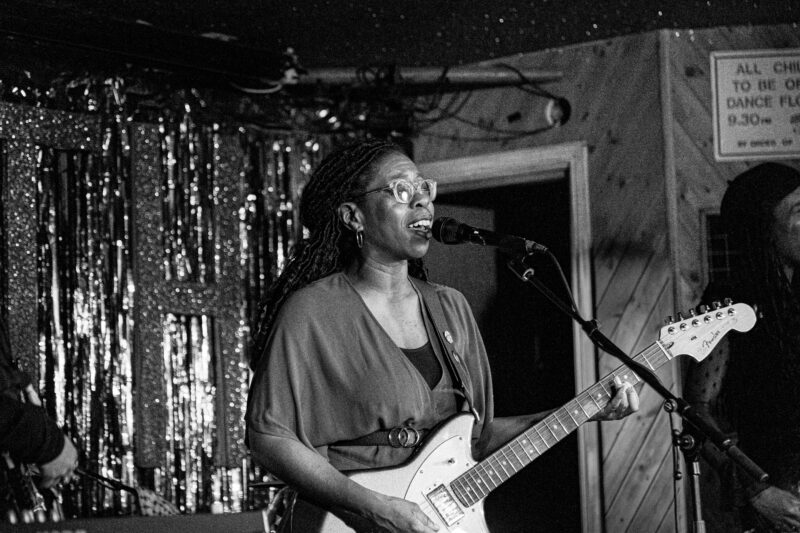
Photo by Jeanie Jean
Stephanie Phillips: When I was growing up in the noughties, the rhetoric was that Black people weren’t into alternative music or punk, and that they don’t have a history there. There was this understanding that we weren’t meant to be there – from both, Black and white people. But once I explored the real history of it, I saw that not only were we there, but we were pivotal to each iteration of all these musical genres, rock and roll, rock, punk, metal, grunge, and so on. The Black people who created rock and roll and listened to it were ignored by the mainstream industry.
The idea of the book is to reaffirm the fact that we aren’t new to this, and we aren’t imposters in these scenes. Alternative music is very much part of our heritage and our culture.
Having been part of this scene for a long time, how did you first get into it?
Researching music and listening to things was my hobby as a teenager and I had a lot of time on my hands to read magazines and look up the bands that were referenced. I felt drawn to female-fronted bands like Bands like PJ Harvey, Le Tigre, Sleater-Kinney. Seeing these powerful, strong women making loud music on stage, and touring the world doing their own thing, that was radical to me. Also, this idea that culture is there for you to create yourself and to get involved with and not just for consumption resonated with me.
Critical Conversations
It has been changing a little bit now with initiatives like Decolonise Fest in London, which you are part of, or the Berlin-based Decolonoize, still alternative, punk, and rock music events are mostly played and attended by white bands and crowds. How was it when you started out?
The erasure of Black musicians from the genre has always been quite evident. I remember first hearing Poly Styrene and being amazed by her voice and the sound. When I saw a picture of her, I realised that she was a Black woman. A lot of people in the punk scene didn’t know that and assumed that she was white. In the UK there wasn’t any conversation around race. There was always this fear about talking about things. I’d be in these majority white spaces, but I knew there had to be lots of other Black people like me. Most just didn’t feel comfortable coming into white alternative and punk spaces for obvious reasons.
For your book, you did a lot of research to retrace the Black roots of alternative music, which have been obscured by the music industry, labels and music journalists alike. When working with archival material, what were some of the hurdles you encountered?
Almost all archival material was written by white male journalists, and their perspective and bias profoundly influence the portrayal of the artists and the music. One example of this is how 90s music magazines talked about the band Skunk Anansie and their lead singer Skin. Even when reviews were positive, she was always described as aggressive or frightening. On top of that, some writers also suggested at being attracted or turned on by her, not only fetishising her but also reproducing the racist stereotype of the angry or ‘difficult’ Black woman. These kinds of depictions can be detrimental to artists and other Black people reading these texts. For me it was important to approach the archival material with a critical eye exposing these types of biases. I also included interviews, oral history and alternative publications like zines in my research, which are ways to circulate and archive knowledge outside of the mainstream publications.
Reclaiming History
Alternative genres, including punk, rock, metal, etc., have their origin in blues and rock and roll music created by Black artists in the early 20th century US. How did these genres then become so white-washed and detached from the communities, that created and laid their very foundations?
There were several things happening. In the 50s and 60s, rock and roll and artists like Chuck Berry and Little Richard got popular. At the same time, there was the Black Power movement and the pushback against racism and segregation. Rock and roll was seen as an influence that would make teenage kids unite across racial barrier. So, there was an emphasis on shutting it down by the white people in power. In the music business this meant that the record industry pushed white rock artists like Elvis to the front. White artists covered songs by Black artists and topped the Billboard pop charts because they had money and the industry behind them. The original creators of the songs rarely got any recognition, most people don’t even know these songs are covers.
 Then there was the British rock and roll invasion of the US, which saw a lot of white UK artists playing blues music they had heard from Black American 50s and 60s artists. To the majority of white audiences in the US, this sounded like something completely new, because the Black artists never got mainstream recognition. By the 60s, rock and roll was being regarded as created by white British artists. Music journalism, which got very popular around that time, also pushed those narratives by mainly portraying white artists.
Finally, during the Black Power movement in the 60s, Black people rejected things associated with the white public. Rock and roll had already been taken over by white artists and was not regarded as Black music anymore. There were other artists like James Brown, the funk movement, Nina Simone, who became anthems for the Black community. Rock and roll, and the subsequent genres, were not seen as authentically Black anymore by Black people themselves.
Contrary to these developments, you write in your book that Blackness is inherently punk.
I talk about Blackness being inherently punk because I think that Black people are already othered, pushed to the side and seen as outsiders. We’re already aware of the need for change and that we don’t live in a world that will give things to us. We have to make things happen for ourselves and protect each other. We know how to build our own culture with what we got. We know how to raise our own funds quickly if we need to help people in our community.
Being Black in a white world is DIY. That is why to me, Blackness is inherently punk.
Punk is driven by anger and rage against the system. Do you think part of why Black people are continuously being erased from that scene is the policing of Black anger?
I think that’s certainly part of it. Punk is about rebelling against a norm, and Black people pay a higher price for deviating from the norm than white people. I talk a bit about it in the book with writer and musician Brontez Purnell. If you’re Black, you’re already being hassled by the police every day, you have to fight to get a good education and to just get by in life. For some, it is simply too dangerous to put a double target on their back and become a punk.
Forming New Networks
Punk subculture is characterised by its DIY-ethos and a rebellious and often anti-establishment political stance. Do you think it still holds radical potential for change?
Yes, I definitely still see radical potential in punk. Especially at times when things are leaning very far right in the UK and around the world, I think alternative music is a really great way of speaking truth to power. There‘s also more Black alternative artists coming up, who don’t feel any type of shame or fear that they’re into this music and scene. Black kids are into metal, punk, indie or whatever and they are not afraid of talking about their experiences and what’s going on in their surroundings. I think there are more connections, also internationally, being formed now and having a network being you, makes it easier to maintain a radical stance.
How do you look at the future of alternative music?
Writing and researching this book made me a lot more excited for the things that could come from younger generations. I think we should foster more intergenerational exchange to root ourselves in our history and to share knowledge. I hope we can make gigs more accessible and affordable for young people, so then they can come and meet older punks and learn about DIY organising from them. But it’s hard. In London, venues keep closing and with them, the meeting spots get lost.
Even if there is more representation for Black alternative kids online, this can’t make up for having a physical space to connect with people. Still, in general, alternative music is not seen as white or a white genre anymore and that gives me hope.
Who is one artist or band you came across during your research that we should definitely check out?
Through this book, I discovering a band called Majesty Crush, who were a Black-fronted shoegazey-type dream pop band from Detroit in the ’90s. They would have been the next big thing, but their record label folded just as they released their album, and they couldn’t get anything going. They’ve re-released their album Love 15 very recently, and it sounds beautiful. So, I’d recommend listening to Majesty Crush.
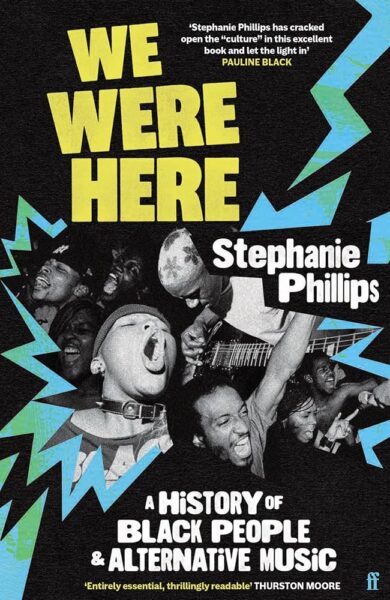
“We Were Here: A History of Black People & Alternative Music” by Stephanie Phillips is out now via Faber. Read an excerpt from the book via The Rolling Stone UK.